

BPJS payroll software for health and employment insurance
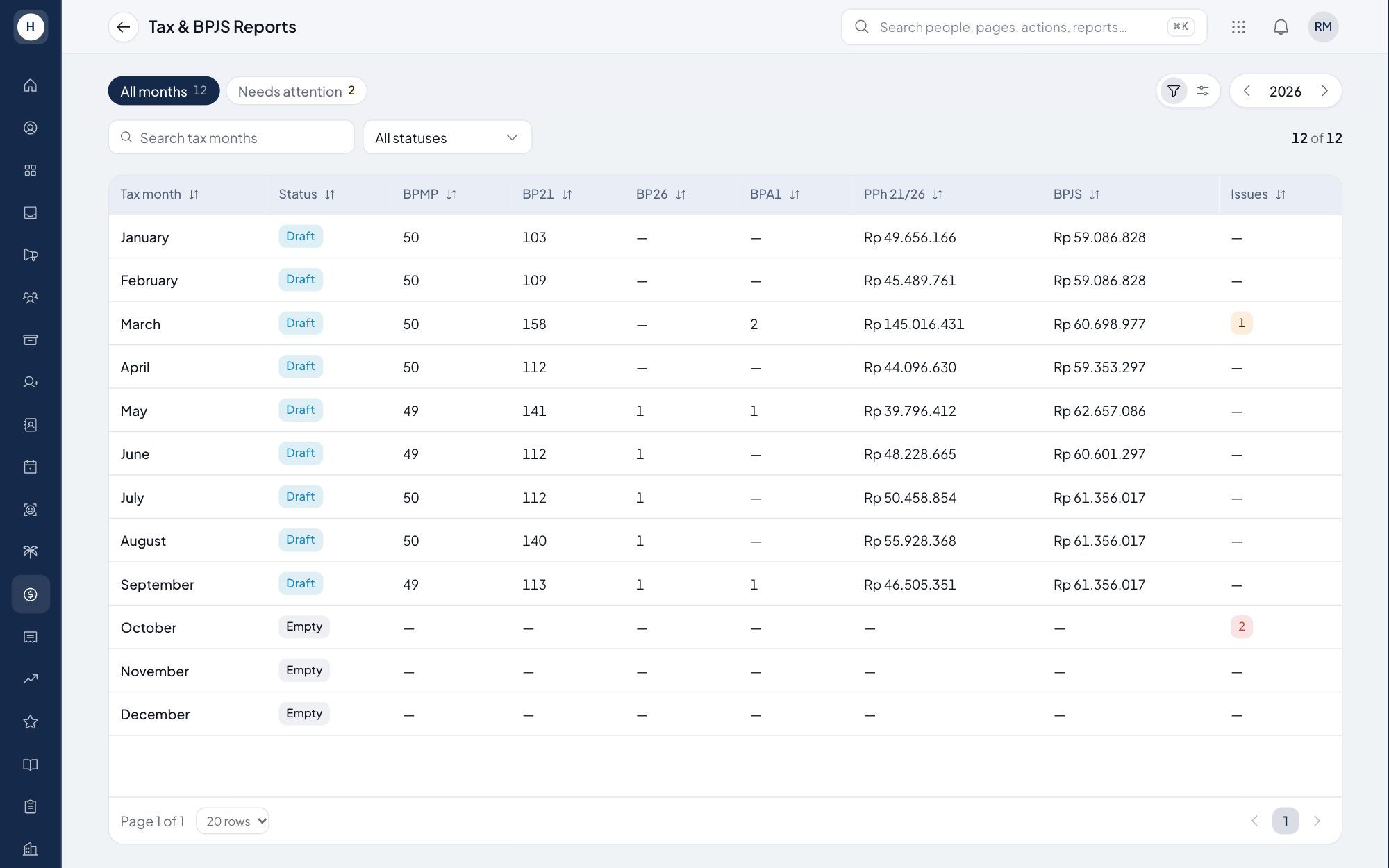
Stavis calculates BPJS Kesehatan and BPJS Ketenagakerjaan contributions for both the employee and the company in every payroll run. Wage caps, JKK risk classes and rates are stored with effective dates, so a rule change never alters past payslips. Each month you get a contribution recap per programme, ready to pay.
What you can do
BPJS Kesehatan
4% company and 1% employee, on wages capped at Rp12,000,000. The company premium is added to taxable gross for PPh 21.
JHT and JP
JHT is 3.7% company and 2% employee with no wage cap. JP is 2% company and 1% employee, with a cap re-indexed every March: Rp11,086,300 from March 2026.
JKK and JKM
JKK follows the workplace risk class and JKM is 0.3%. Both are paid by the company and included in the PPh 21 base.
Recap per programme
The monthly BPJS recap shows employee and company contributions per programme and exports to Excel.
How it works
- 1
Set up coverage
Choose which employee categories are enrolled in BPJS and set the company's JKK risk class.
- 2
Run payroll
Contributions are calculated from wages using the cap in force on the pay date. Every amount has a calculation note.
- 3
Pay from the recap
Open the month's BPJS recap, match it against the bill and pay the contributions.
Frequently asked questions
What is the BPJS Kesehatan contribution rate?
5% of wages in total: 4% paid by the company and 1% deducted from the employee. Wages are capped at Rp12,000,000 a month.
What is the JP wage cap for 2026?
The JP cap is re-indexed every March. From March 2026 it is Rp11,086,300, with contributions of 2% company and 1% employee.
Are employer BPJS contributions taxable?
Employer-paid BPJS Kesehatan, JKK and JKM premiums are added to gross income for PPh 21. Employer JHT and JP contributions are not.
What happens when BPJS rates or caps change?
BPJS rules are stored with effective dates. New payroll runs use the new rule, while older payslips keep the rule that applied at the time.
See Stavis with your own company
Bring one department, one shift pattern and one month of payroll. We will walk through it with you.
